
The civil rights movement in India has emerged as an autonomous voice in defense of civil liberties and democratic rights of our people. The Peoples Union for Democratic Rights, Delhi, is one such organisation. It came into existence in 1977 as the Delhi unit of a larger national forum, PUCLDR, and became PUDR on 1 February, 1981.
Sections
Latest Publications
Fettering People’s Rights: A Critique of Selected Offences and Punishments in The Bharatiya Nyaya Sanhita, 2023
This report is a critique of three legislations, namely Bharatiya Nyaya Sanhita, 2023 (BNS), Bharatiya Nagarik Suraksha Sanhita, 2023 (BNSS) and Bharatiya Sakshya Adhiniyam, 2023, those were passed by the 17th Lok Sabha in December 2023. To download the report click...
Fatal confrontation: custodial death of suraj prakash, adarsh nagar police station, delhi
PUDR investigation in to the death of Suraj Prakash Pawar, a 32-year-old man from Majlis Park in North West Delhi, who died on 27 November 2023 in police custody at the Adarsh Nagar Police, Station, Delhi. PUDR had met the family and an eyewitness, and also spoke to...
Justice for Stan Swamy
A Long Battle for Justice
Workers of Bellsonica Auto Component India Private Limited at the Industrial Model Township (IMT) Manesar in the National Capital Region of India have been sitting on relay hunger strike outside their factory since 4 May 2023, protesting against the spate of recent...
Probing the Jahangirpuri Communal Incident, Delhi, 2022
Jahangirpuri in northwest Delhi came into the headlines when an outbreak of communal violence took place in the course of a confrontation between some Hindus and Muslims during a Hanuman Jayanti procession on 16 April 2022. Two FIRs (nos. 440 and 441 of 2022,...
Latest Press Statements
Uphold Shoma Sen’s Bail Order: Release all Bhima Koregaon detainees!
PUDR expresses relief at the Supreme Court’s granting of bail to Prof. Shoma Sen on April 5, after nearly six long years of pre-trial incarceration. Charged under the Unlawful Activities (Prevention) Act in the infamous Bhima Koregaon (BK) conspiracy case, Shoma Sen...
Supreme Court offers a timely reminder on the scope of fundamental freedoms
PUDR welcomes a recent judgment by the Apex court as a timely reminder that liberty of speech and expression is a right fundamental to the citizens of India and restrictions imposed on it must be reasonable. On 7 March, the Supreme Court quashed an FIR against a...
Release of Report entitled, Fettering People’s Rights: A Critique of Selected Offences and Punishments in The Bharatiya Nyaya Sanhita, 2023
On 20th and 21st December 2023, the Parliament enacted three new laws, the Bharatiya Nyaya Sanhita, (BNS), Bharatiya Nagarik Suraksha Sanhita, (BNSS) and Bharatiya Sakshya Adhiniyam. These Codes replace the Indian Penal Code (IPC) of 1860, the Code of Criminal...
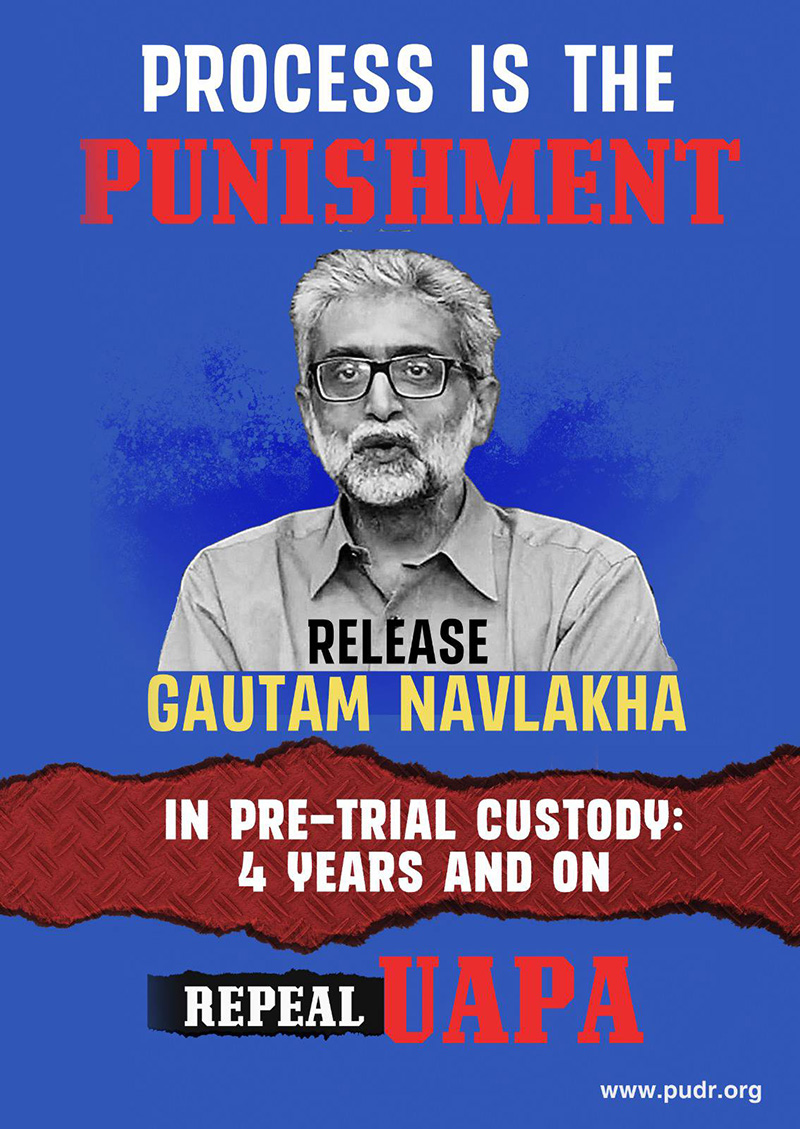
PUDR welcomes the Bombay High Court order granting regular bail to Gautam Navlakha
PUDR welcomes the Bombay High Court order granting regular bail to Gautam Navlakha, a well-known civil rights activist, author, and journalist, on December 19, 2023. The two-member bench comprising Justices AS Gadkari and Shivkumar Dige ruled that based on a perusal...
Life Imprisonment till Death: A regime of retributive punishments under Bharatiya Nyaya Sanhita
PUDR welcomes the revision in the definition of ‘Life Imprisonment’ in Clause 4 (b) in Chapter II (“Of Punishments”) in the revised draft of the Bharatiya Nyaya Sanhita (BNS II). Contrary to the earlier draft (BNS I) in which “Imprisonment for life” in Chapter II was...