
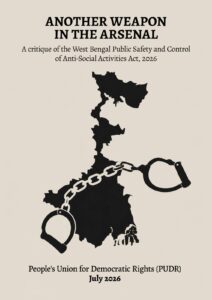
 People’s Union for Democratic Rights (PUDR)’s report, ‘Another Weapon in the Arsenal: A critique of the West Bengal Public Safety and Control of Anti-Social Activities Act, 2026 and the West Bengal Maintenance of Public Order (Amendment) Act, 2026’ examines two laws enacted by the recently elected BJP-led West Bengal government. The report highlights how the two laws that came into force on 13th July, construct a coercive apparatus that reaches deep into the ordinary civic and political life of the people by bearing heavily on the exercise of their fundamental freedoms. This coercive apparatus, however, is built not through new invention, but through a fresh assembly of old provisions, with diluted safeguards.
WEST BENGAL PUBLIC SAFETY AND CONTROL OF ANTI-SOCIAL ACTIVITIES ACT, 2026 (THE NEW GOONDA ACT): OLD POWERS, WATERED-DOWN CHECKS
The report traces the Act’s century-long lineage, from the 1923 Bengal Goondas Act to state-specific Goonda Acts of the 1970s and 80s, and the National Security Act (NSA). The 2026 Act is unique as in converges the historically compartmentalized existence of repressive provisions- externment, preventive detention, police powers of search/seizure, and punitive offences related to harbouring/concealment- into a single statute. That these provisions are meant to reach far beyond ordinary criminality to identify specific targets, is clear from its own Statement of Objects and Reasons, which states that ‘certain sections of the society are engaging in anti-social activities’, ‘posing a threat to the bonafide citizens of the state’ through their ‘nefarious activities’. It allows for ‘certain sections’ to be placed outside the category of the bonafide citizens, whose activities can be rendered ‘nefarious’. The Act’s constitutional validity is currently under challenge before the Calcutta High Court.
- Who is a Goonda: A goonda is a person under the Act who is likely to or engages in ‘anti-social activity’ defined in its widest import such as ‘acts likely to cause, alarm, danger, fear or insecurity among the general public’, or disturbance of ‘public tranquillity’, or obstruction of trade, etc. The definitional reach can include strikes, protests, or any dissenting activity and any person ‘habitually’ engaging in them can be the target of the law.
- Preventive Detention of a Goonda: The State Government, or a District Magistrate or Commissioner of Police, can order a person’s detention as a ‘goonda’ based on subjective satisfaction, to ‘prevent’ them from engaging in anti-social activity, for a year. Fresh detention can be ordered on expiry of the previous order, with no limitation on the period of detention- a deliberate gaping hole has been created for potentially prolonged detention. The grounds of detention can be withheld citing public interest, security, or source confidentiality. The Advisory Board (comprising current/former High Court judge plus two members) is expected to review detention within nine weeks but the detainee has no right to legal representation before it.
- Comparison with NSA: The West Bengal Act extends and enhances the NSA-laid preventive detention provisions. The Act doubles the penalty for absconding accused, extends the Advisory Board’s timeline, omits the NSA’s specifications regarding time period of fresh detention, adds extra provisions related to externment of and harbouring by accused and search-seizure-disposal of property.
- Charge-sheet, not conviction as basis for detention: Most significantly, under this law, a person qualifies as a ‘goonda’ on the basis of past charge-sheets, a provision that allows for double jeopardy as a person cannot be penalised twice in the same matter.
- Reputation based penalty: The Act also allows a person to be defined as a ‘goonda’ based on general reputation of being ‘desperate and dangerous to the community’, requiring no accusation at all. Reputation allows for targeting and criminalizing ‘certain sections’ emphasised in the Act’s objective.
- Externment without judicial review: A ‘goonda’ under this Act can be externed for up to a year, without any Advisory Board oversight at all. Appeal against externment can be made only to the state government, the authorizing body for externment. Breach of an externment order can lead to up to three years of imprisonment.
- Harbouring, with no spousal exception: Additionally, the law creates punitive offences such as harbouring or concealing a person under detention/externment orders, punishable by up to two years’ imprisonment. Unlike the UAPA, the WB Act does not exempt spouses living in the same house.
WEST BENGAL MAINTENANCE OF PUBLIC ORDER (AMENDMENT) ACT, 2026: A COMPENSATION REGIME WITHOUT A COURT
The 2026 amendment to the West Bengal Maintenance of Public Order Act, 1972, establishes a Claims Commission– a body of state executive officers with authority to impose financial liability for damage to property, in cases of unrest, not only on those involved in physical damage but also on organisers, instigators, abettors, sponsors and harbourers, along with powers to attach and sell their property to recover the sums awarded to the victims of damage. Interestingly, state itself can be a victim, and can take over the property of the accused to compensate itself.
Powers to attach and adjudicate property outside ordinary civil courts already exist under the Prevention of Money Laundering Act (PMLA), 2002, and under Section 107 of the BNSS, but they are subject to judicial oversight that the West Bengal 2026 Amendment does away with. Under PMLA, attachment/confiscation becomes final only after a conviction and property is released in cases of acquittal, while there remains a right of appeal, first to the Appellate Tribunal, then to the High Court, against property take-over. Under BNSS too, similar powers to officials remain subject to ordinary judicial appeal.
By contrast, under the West Bengal 2026 Amendment, financial liability imposed by Claims Commission is payable independent of conviction or acquittal and there is no provision for return of property. The Commission’s decision cannot be challenged in any court, creating a regime that goes further than the executive-heavy but still judicially chequered scheme under PMLA.
The Claims Commission model is drawn directly from recent laws enacted by BJP-led governments in states such as Uttar Pradesh (2020), Haryana (2021) and Uttarakhand (2024). These laws themselves bypass the Supreme Court’s guidelines in In Re: Destruction of Public & Private Property v. State of A.P. (2009), asking for liability to be decided by sitting or retired High Court judges, and not executive officers. West Bengal’s 2026 Amendment brings this same model to West Bengal, with BJP coming into power, following the same script.
The two enactments together function as a catch-all structure creating a regime capable of proscribing a person, not only through deprivation of liberty and arbitrary penalties but also by implicating their family and property, without the need for a single conviction being secured against them. The label ‘goonda,’ unlike a charge under the NSA, strips a political dissenter of any recognition as a political actor at all, before the question of guilt is even raised.
PUDR demands the repeal of both the West Bengal Public Safety and Control of Anti-Social Activities Act, 2026, and the West Bengal Maintenance of Public Order (Amendment) Act, 2026.
Deepika Tandon and Shahana Bhattacharya
(Secretaries)
pudr@pudr.org
To download the full report click below
https://www.pudr.org/publicatiosn-files/2026-7-WB-ACT.pdf


